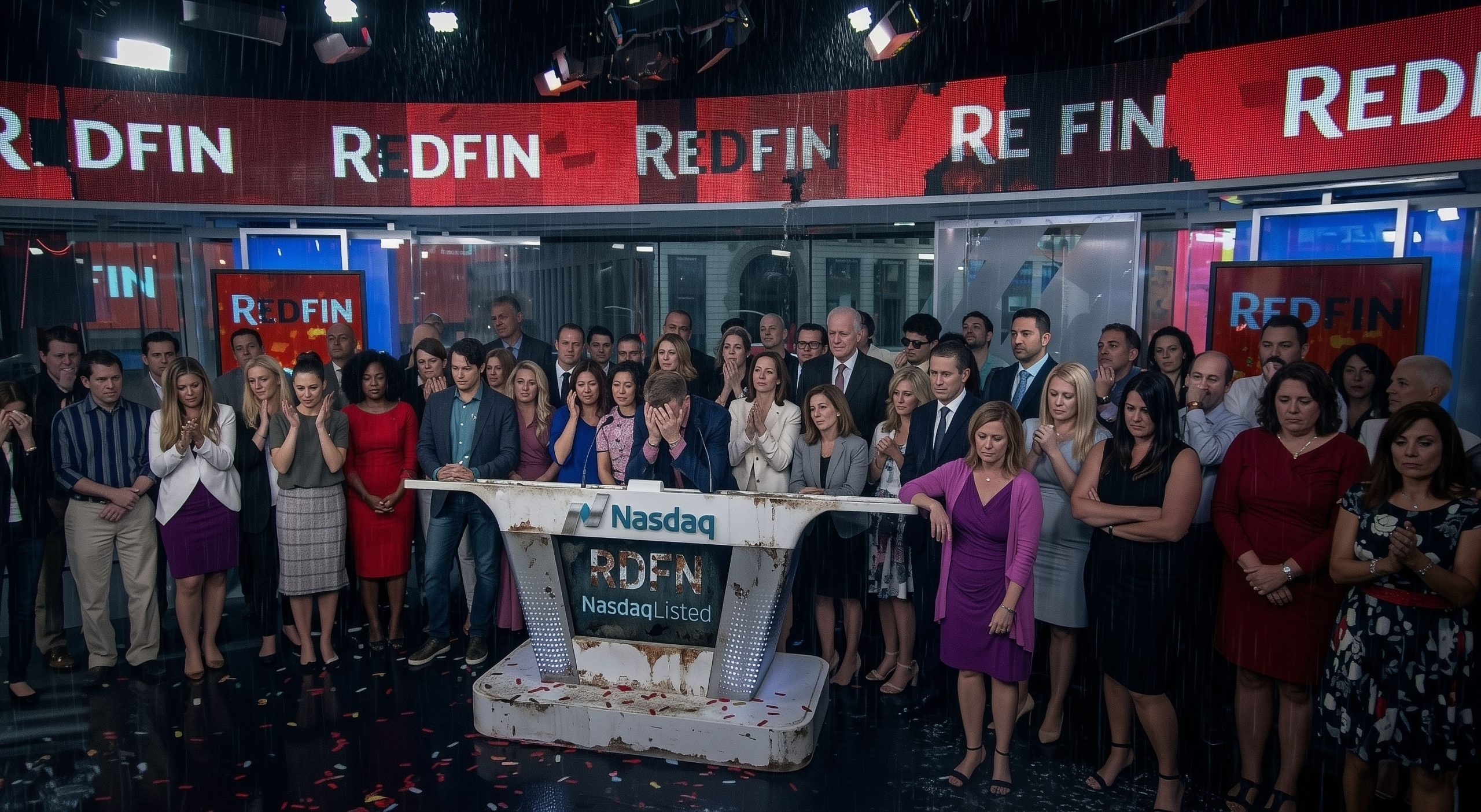
Now that a year has passed since Rocket Companies completed its acquisition of Redfin and it’s been six months since Redfin had its own CEO, I thought it would be worth reflecting on what Redfin accomplished during its two-decade run as an independent company and how the Redfin of 2026 became exactly the kind of company that the Redfin of 2007 was created to fight against.
A Fiery Beginning
Although it was founded in 2004, it wasn’t until 2007 that Redfin really hit the national scene in a big way when its CEO went on 60 Minutes and called real estate “by far the most screwed up industry in America.” For most of their existence, their stated core mission was to “redefine real estate.”
At the beginning, Redfin’s strategy to pull off this mission was based on two core differentiators that made them different from traditional real estate brokerages:
- A big commission refund to homebuyers and low flat fees for sellers.
- Salaried agents that earn bonuses based on customer satisfaction rather than commission.
As explained in the 60 Minutes appearance, Redfin in 2007 charged a flat fee of just $3,000 to represent a home seller and refunded two thirds of the commission to home buyers. And Redfin’s crusade against commissions wasn’t just about saving customers money—the way they compensated their agents was revolutionary, as well. Here’s the CEO railing against paying agents on commission in a 2007 post on their site:
But our problem with commissions is not simply that they’re too high; our problem is with the commission itself, because it pays the buyer’s agent more when his clients pay more. In other words, rather than being offset by better negotiations, the buyer agent’s commission actually causes worse negotiations.
This is why we decided to pay Redfin agents a salary with a customer satisfaction bonus, not a commission. Agents do what you pay them to do, we reasoned, and we believed our agents would be more likely to get the price our customers wanted.
It was this passion and pro-consumer mission that drew me to work for Redfin, first from 2010 to 2013 then again from 2018 to 2022. Throughout my time at the company I worked with lots of smart, passionate people who were also committed to this mission, but in the end, it didn’t matter…
The Fire Fizzles Out
Unfortunately, over time the “most screwed up industry” ended up redefining Redfin a lot more than the other way around.
By the time Rocket acquired them in 2025 Redfin was charging home sellers a straight 2% commission (1% if you also buy with them) and if there is any commission refund at all still going to buyers they certainly aren’t advertising it anywhere.
At some point along the line their customer-satisfaction-focused agent pay model was also completely tossed out the window. These days their agent recruiting page touts “a big traditional split” of the commission for agents that come to work for Redfin. I guess they didn’t have such a big “problem with commissions,” any more. Honestly I’m not even sure why a homebuyer would choose to work with Redfin today, as there seems to be virtually nothing that differentiates them from every other real estate brokerage anymore.

Maybe it was an unwinnable fight from the beginning. Maybe the real estate industry is just too entrenched. Or maybe a total abandonment of pro-consumer principles was baked in from the start by the venture capital funds that backed the company. One way or another, it seems that enshittification was inevitable, which is truly sad because there were always a lot of people at Redfin who really believed in making real estate better for consumers. We just never figured out how to get those consumers to be as passionate about the change as we were.
Where’s the Beef?
So what did Redfin accomplish by completely throwing out their founding ideals and going all-in on traditional real estate commissions? Not much, it turns out. Here’s how the company performed between 2005 and 2025:
- Profit: Never turned an annual profit.
- Growth: Never broke above single-digit market share.
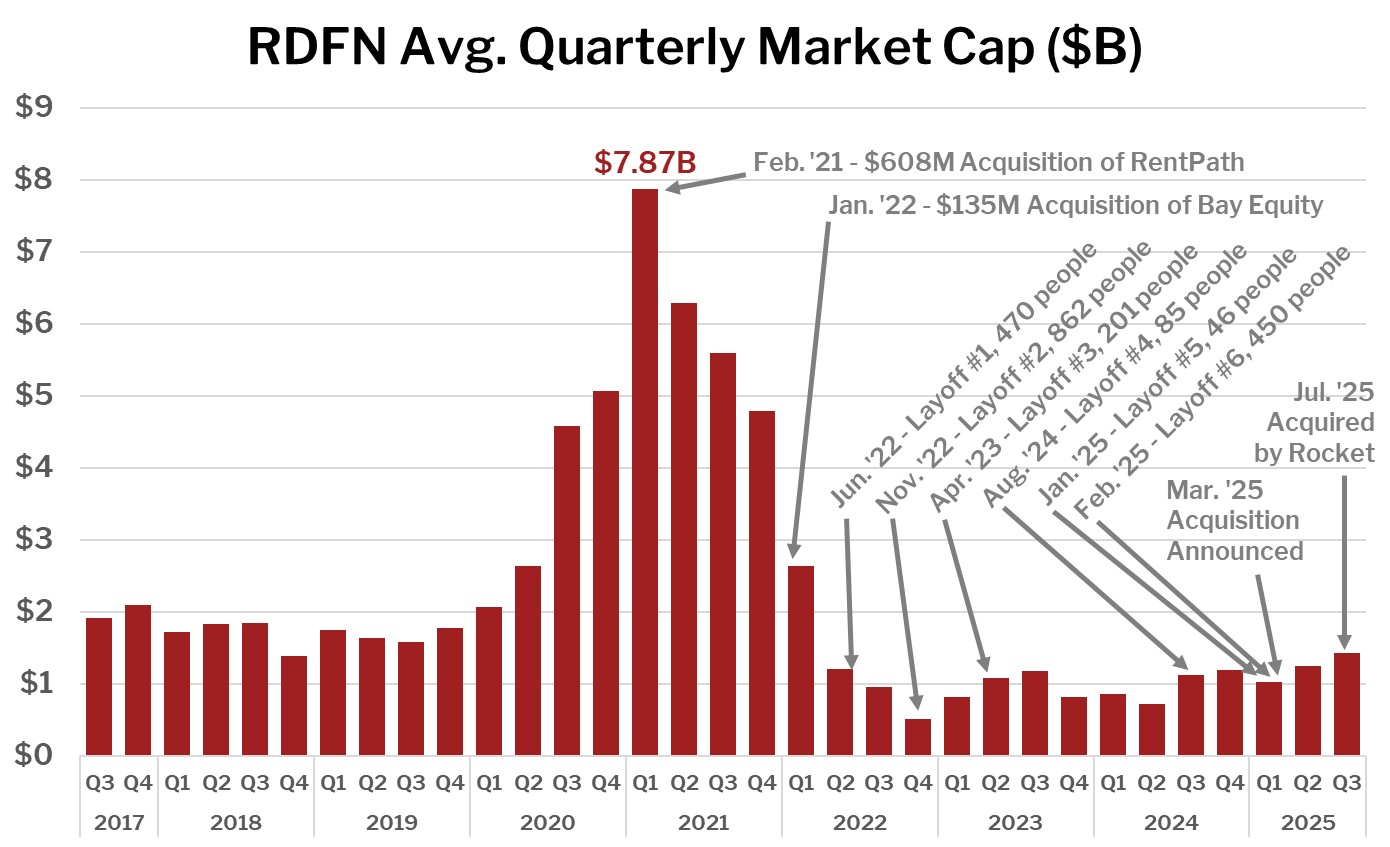
- Capital: Blew $743 million on two big acquisitions (RentPath & Bay Equity) that never improved their bottom line.
- Labor: Cut over a quarter of their employees across six rounds of layoffs when the market softened.
And in the end, the value of the company was barely changed during their entire time as an independent public company, selling out to Rocket eight years post-IPO for $1.75B—just 3% above their $1.7B market cap at the close of trading on the day of the 2017 IPO.
It’s worth noting that despite all of this, and the fact that my own job was eliminated in the second of those six layoffs, I do still own a few shares of what was Redfin and is now Rocket stock. I guess some part of me still can’t fully let the dream go.
Nothing Left to Get Excited About
In 2026 as part of Rocket Companies, Redfin spent at least $8 million (probably quite a bit more) to run its first ever Super Bowl ad, a fitting cap on its decades-long transition from feisty disrupter to milquetoast mainstream also-ran. But will a Super Bowl ad finally be the thing that breaks them through to the masses? Well, a week after the game I asked my parents if they had seen the ad. They said they hadn’t, so I began describing it to them, and then they realized they had seen it, but did not realize it was an ad for Redfin. This is despite the fact that they are more primed than the average consumer to notice Redfin, given that I worked there for over seven years.
In two decades, Redfin went from landing a glowing 60 Minutes segment for free with a memorable, fiery tirade about a screwed up industry to paying millions to push a generic, mushy message that doesn’t even register as their own. To me that doesn’t feel anything like success—it feels like a whole lot of missed opportunity.
I’m intentionally not naming any names here because again, I worked with a lot of smart, capable, and good people at Redfin. My coworkers were kind and welcoming, and the company fostered a lot of great talent. In fact I’m very glad to be working with many of them again at a different company today. The sad reality is that the eventual tragic trajectory of Redfin was likely baked in from the beginning—we were all just along for the ride.
The Redfin dream of redefining real estate was—and still is—exciting, but in retrospect the way things played out just leaves me with a very different feeling: disappointment.