The struggle to be unemployed: Life after a Redfin layoff

Note: I wrote this as a sort of response to the post How to be unemployed: Glenn Kelman on life after Redfin posted to GeekWire on Friday


In June of 2022, Redfin laid off 470 people. When the layoff was announced, those of us who remained were given a one-time stock grant to incentivize us not to jump ship, and assured that the cuts had been thoughtful and deep enough to position the company “to become profitable, and then very profitable” and to face “years, not months, of fewer home sales.” Five months later another 862 people, including me this time, had our jobs taken from us in the second of what would eventually be six rounds of layoffs.

Just two weeks earlier, my wife and I learned that she was pregnant. What should have been a joyous and exciting time in our life instead became one of the most stressful, soul-crushing periods I’ve ever had to face. Instead of looking forward to taking advantage of Redfin’s generous paternal leave, I now had to worry about how I’d be paying my mortgage. At the time my wife’s tea and spice shop Chai Cupboard was still costing us money (that’s a whole different story), so our family depended entirely on my income. While I did receive a severance of about three months’ worth of salary, none of the post-first-layoff-stock grant was vested. The reward for those of us who took leadership at its word in June was basically a slap in the face.

After a couple of months of intensive job hunting, I was “lucky” enough to get a job offer. “Lucky” is in quotes here because the pay was below what I had been making before, the medical insurance was paltry, and other benefits—including any time off for the impending birth of my son—were non-existent. Plus, I wasn’t really sure what the company even did. But once I had a job offer in hand, I had to take it or I’d lose my paltry unemployment benefits, putting us in a far worse financial condition.

As it turned out, there was a reason the company was cagey about the nature of their business… it was basically a scam. Or at least highly scam-adjacent. I held out as long as I could, thinking that at least I’d be better off having medical insurance when my son was born, even if I wouldn’t be able to take any time off. Well the joke was on me yet again, because even after insurance we ended up with over $20,000 in debt to the hospital that we couldn’t afford to pay. As you might imagine, my time at this company did not last more than a handful of months before I was back to being unemployed, now with a newborn baby at home.
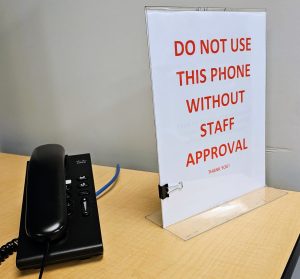
The secret unemployment phone at WorkSourceFor whatever reason, the Washington State unemployment office took an unusually long time to begin sending me benefits. After applying, I waited, and waited, and waited. I would regularly call the office—a line which has only a recorded message and zero options to ever speak to an actual person—only to consistently hear that decisions are made in “four to six weeks.” After seven weeks and no response, I went down to the local WorkSource office and discovered the secret phone that connects to an actual person at the unemployment office (yes, this is a real thing, see the picture). Not that it helped. All they would tell me was that they hadn’t even assigned someone to my case yet, and they couldn’t even say when they would. Finally, eight weeks after losing the scammy job, the unemployment checks started flowing again. Which, by the way, were capped at about a third of what I had previously been earning.

Over the next 14 months, I applied to over 600 jobs, customized my resume more times than I can count, wrote hundreds of thoughtful cover letters (on my own—without using AI), and networked with every past colleague I could think of. 98 percent of these applications received either a form letter rejection or no response at all.
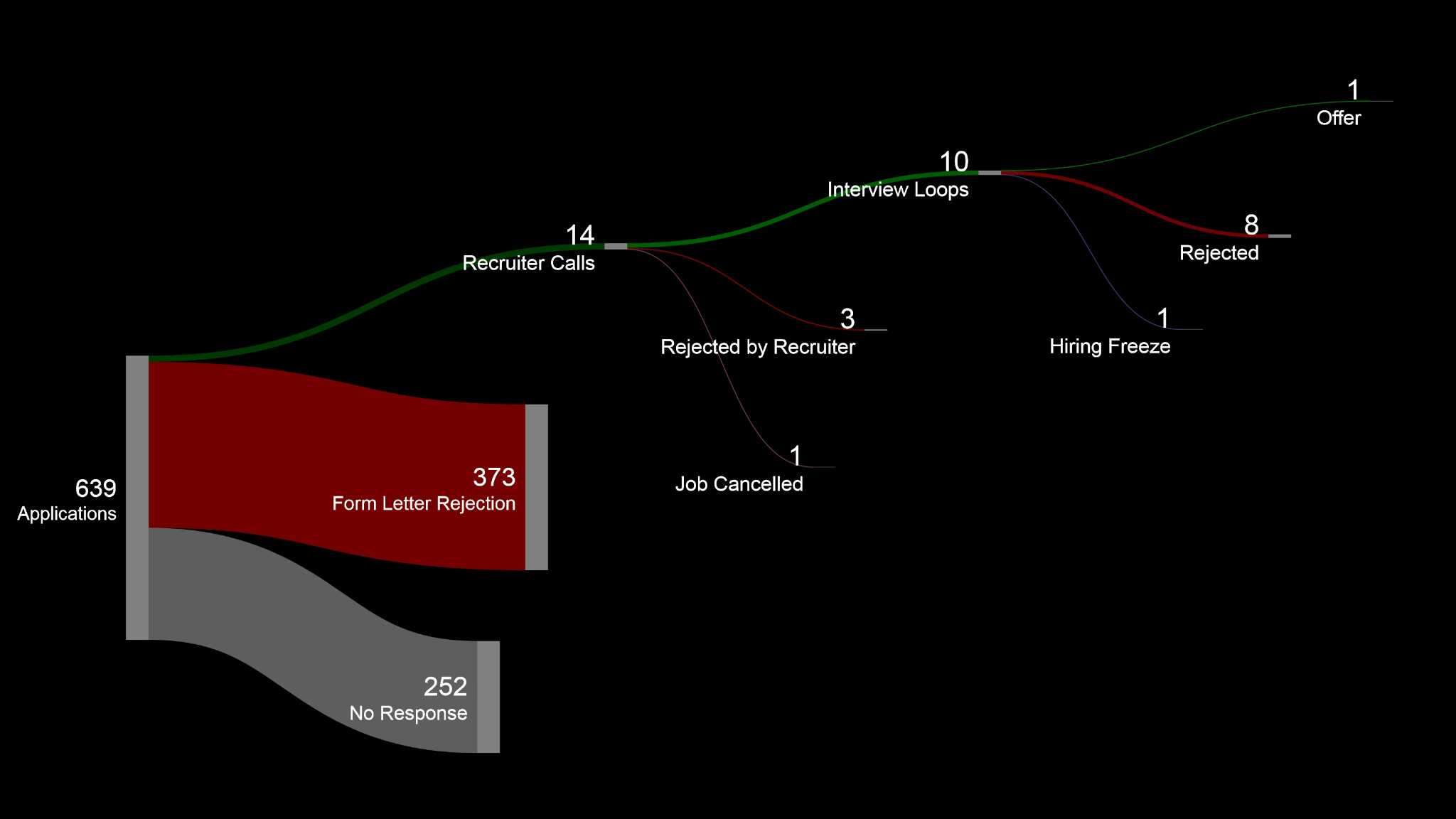
job search Sankey diagram

By December of 2023, my savings ran out. The following March I swallowed my pride and started a GoFundMe to beg friends and family to help us out. In May, I decided to finally call it: my career in the tech industry was over. It was time to look elsewhere to support my family. In June, I hit the 26-week cap on unemployment benefits, taking my income all the way to zero.

For me, unemployment was not a time for navel-gazing and waxing philosophical about the nature of work, it was survival mode. I spent most of my time desperately trying to find a new job. I was too broke to take a road trip I had been planning with extended family for years to see the total eclipse in April 2024. I couldn’t afford to be picky about what I wanted to do next. I was ready to take any job that fit my skills and would pay the bills. I even interviewed for a position at a company whose sole mission is to aid coffee farmers, and I hate coffee.

In the conclusion of my May post calling it quits on tech, I wrote that only a “deus ex machina resolution” would keep me in the industry. Wikipedia describes “deus ex machina” as a situation in “which a seemingly unsolvable problem in a story is suddenly or abruptly resolved by an unexpected and unlikely occurrence.” Literally just as my unemployment was running out in June, that unexpected and unlikely occurrence came when a former Redfin coworker (who had left before any of the layoffs started) reached out to connect me with someone with his team. Even though they didn’t have any open roles at the time, he thought it would be good for us to chat.

By the time I had that chat a few weeks later, a role had just opened up, and I immediately began the official interview process. Two months later I finally had a new job at a healthy, growing startup with a solid product, great financials, and a very enthusiastic customer base. The pay was still about 15% less than what I used to make at Redfin, not counting stocks—23% less after accounting for the 10% inflation during my nearly two-year period of career purgatory. But nonetheless I am extremely grateful and happy to be working again.

Today I’m more than two years into my new job, and it feels good to be employed, but our savings account still sits near zero, and the hospital debt is unpaid. My story is just one of the 2,114 unemployment experiences brought on by Redfin’s layoffs, which themselves are a drop in the bucket of the hundreds of thousands of layoffs brought on by AI and the end of the ZIRP era of free money. And I know that my story is not the most difficult—at least it has a happy ending! The company I’m at now is in great shape and the leadership team has been nothing but honest with me, but I frequently catch myself expecting bad news just around the corner. The paychecks came back, but the financial and emotional scars remain.


P.S.: I didn’t use AI to write this, either—I have always made good use of the em dash, and I’m not going to stop just because some expensive computers have decided it’s trendy now.


A rainy night scene, sad man walks down the street, the old Redfin logo is on the side of a building.

Requiem for a real estate dream: a Redfin retrospective

Now that a year has passed since Rocket Companies completed its acquisition of Redfin and it’s been six months since Redfin had its own CEO, I thought it would be worth reflecting on what Redfin accomplished during its two-decade run as an independent company and how the Redfin of 2026 became exactly the kind of company that the Redfin of 2007 was created to fight against.

A Fiery Beginning

Although it was founded in 2004, it wasn’t until 2007 that Redfin really hit the national scene in a big way when its CEO went on 60 Minutes and called real estate “by far the most screwed up industry in America.” For most of their existence, their stated core mission was to “redefine real estate.”

At the beginning, Redfin’s strategy to pull off this mission was based on two core differentiators that made them different from traditional real estate brokerages:

  1. A big commission refund to homebuyers and low flat fees for sellers.
  2. Salaried agents that earn bonuses based on customer satisfaction rather than commission.

As explained in the 60 Minutes appearance, Redfin in 2007 charged a flat fee of just $3,000 to represent a home seller and refunded two thirds of the commission to home buyers. And Redfin’s crusade against commissions wasn’t just about saving customers money—the way they compensated their agents was revolutionary, as well. Here’s the CEO railing against paying agents on commission in a 2007 post on their site:

But our problem with commissions is not simply that they’re too high; our problem is with the commission itself, because it pays the buyer’s agent more when his clients pay more. In other words, rather than being offset by better negotiations, the buyer agent’s commission actually causes worse negotiations.

This is why we decided to pay Redfin agents a salary with a customer satisfaction bonus, not a commission. Agents do what you pay them to do, we reasoned, and we believed our agents would be more likely to get the price our customers wanted.

It was this passion and pro-consumer mission that drew me to work for Redfin, first from 2010 to 2013 then again from 2018 to 2022. Throughout my time at the company I worked with lots of smart, passionate people who were also committed to this mission, but in the end, it didn’t matter…

The Fire Fizzles Out

Unfortunately, over time the “most screwed up industry” ended up redefining Redfin a lot more than the other way around.

By the time Rocket acquired them in 2025 Redfin was charging home sellers a straight 2% commission (1% if you also buy with them) and if there is any commission refund at all still going to buyers they certainly aren’t advertising it anywhere.

At some point along the line their customer-satisfaction-focused agent pay model was also completely tossed out the window. These days their agent recruiting page touts “a big traditional split” of the commission for agents that come to work for Redfin. I guess they didn’t have such a big “problem with commissions,” any more. Honestly I’m not even sure why a homebuyer would choose to work with Redfin today, as there seems to be virtually nothing that differentiates them from every other real estate brokerage anymore.

meme image: "Congratulations, you disrupted yourself"

Maybe it was an unwinnable fight from the beginning. Maybe the real estate industry is just too entrenched. Or maybe a total abandonment of pro-consumer principles was baked in from the start by the venture capital funds that backed the company. One way or another, it seems that enshittification was inevitable, which is truly sad because there were always a lot of people at Redfin who really believed in making real estate better for consumers. We just never figured out how to get those consumers to be as passionate about the change as we were.

Where’s the Beef?

So what did Redfin accomplish by completely throwing out their founding ideals and going all-in on traditional real estate commissions? Not much, it turns out. Here’s how the company performed between 2005 and 2025:

  • Profit: Never turned an annual profit.
  • Growth: Never broke above single-digit market share.
  • Capital: Blew $743 million on two big acquisitions (RentPath & Bay Equity) that never improved their bottom line.
  • Labor: Cut over a quarter of their employees across six rounds of layoffs when the market softened.

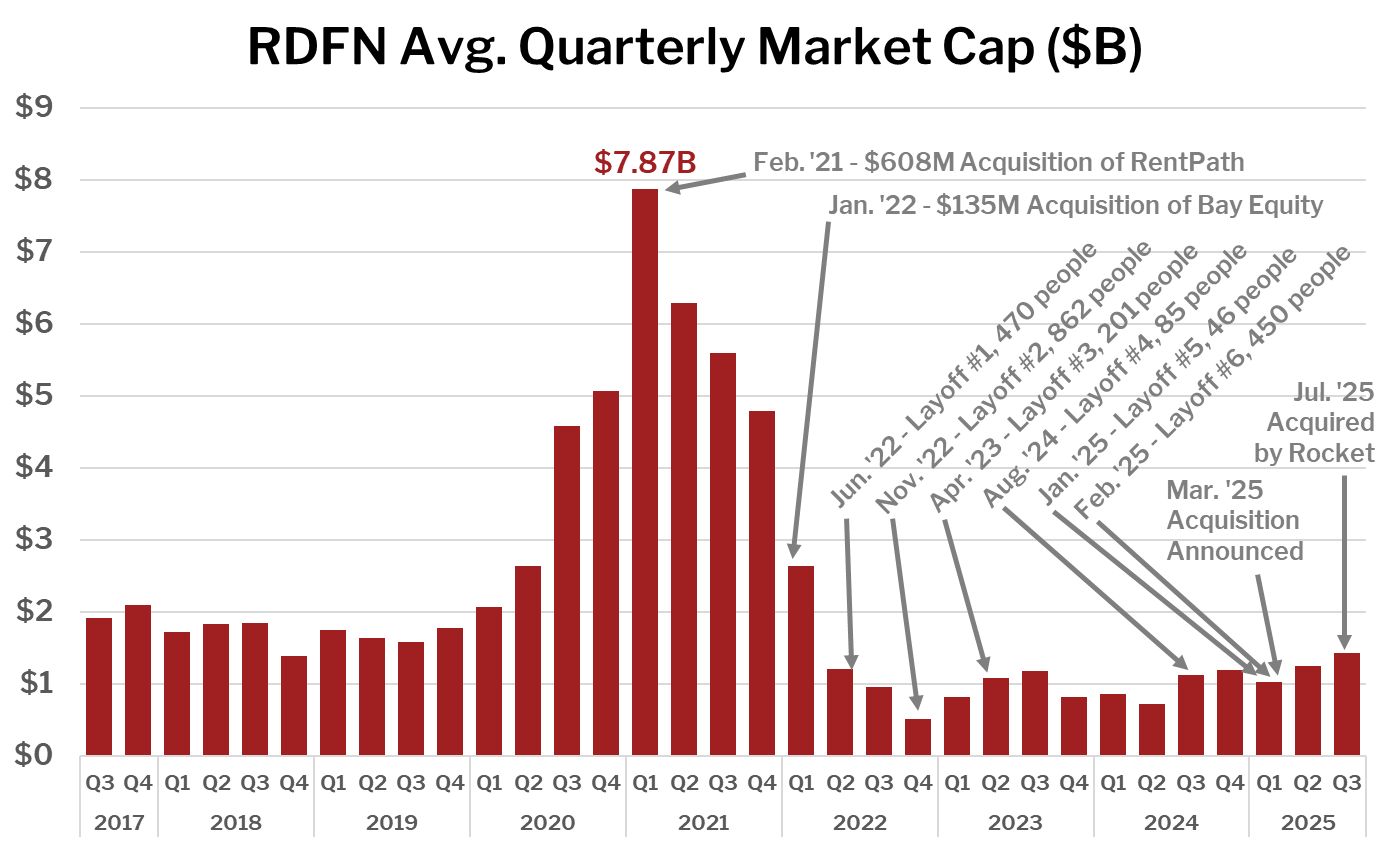
And in the end, the value of the company was barely changed during their entire time as an independent public company, selling out to Rocket eight years post-IPO for $1.75B—just 3% above their $1.7B market cap at the close of trading on the day of the 2017 IPO.

Bar chart showing Redfin average quarterly market cap in billions of dollars. Starts at just below $2 billion in late 2017, surges to just under $8 billion in 2021, falls to just under $2 billion by late 2025.

It’s worth noting that despite all of this, and the fact that my own job was eliminated in the second of those six layoffs, I do still own a few shares of what was Redfin and is now Rocket stock. I guess some part of me still can’t fully let the dream go.

Nothing Left to Get Excited About

In 2026 as part of Rocket Companies, Redfin spent at least $8 million (probably quite a bit more) to run its first ever Super Bowl ad, a fitting cap on its decades-long transition from feisty disrupter to milquetoast mainstream also-ran. But will a Super Bowl ad finally be the thing that breaks them through to the masses? Well, a week after the game I asked my parents if they had seen the ad. They said they hadn’t, so I began describing it to them, and then they realized they had seen it, but did not realize it was an ad for Redfin. This is despite the fact that they are more primed than the average consumer to notice Redfin, given that I worked there for over seven years.

In two decades, Redfin went from landing a glowing 60 Minutes segment for free with a memorable, fiery tirade about a screwed up industry to paying millions to push a generic, mushy message that doesn’t even register as their own. To me that doesn’t feel anything like success—it feels like a whole lot of missed opportunity.

I’m intentionally not naming any names here because again, I worked with a lot of smart, capable, and good people at Redfin. My coworkers were kind and welcoming, and the company fostered a lot of great talent. In fact I’m very glad to be working with many of them again at a different company today. The sad reality is that the eventual tragic trajectory of Redfin was likely baked in from the beginning—we were all just along for the ride.

The Redfin dream of redefining real estate was—and still is—exciting, but in retrospect the way things played out just leaves me with a very different feeling: disappointment.

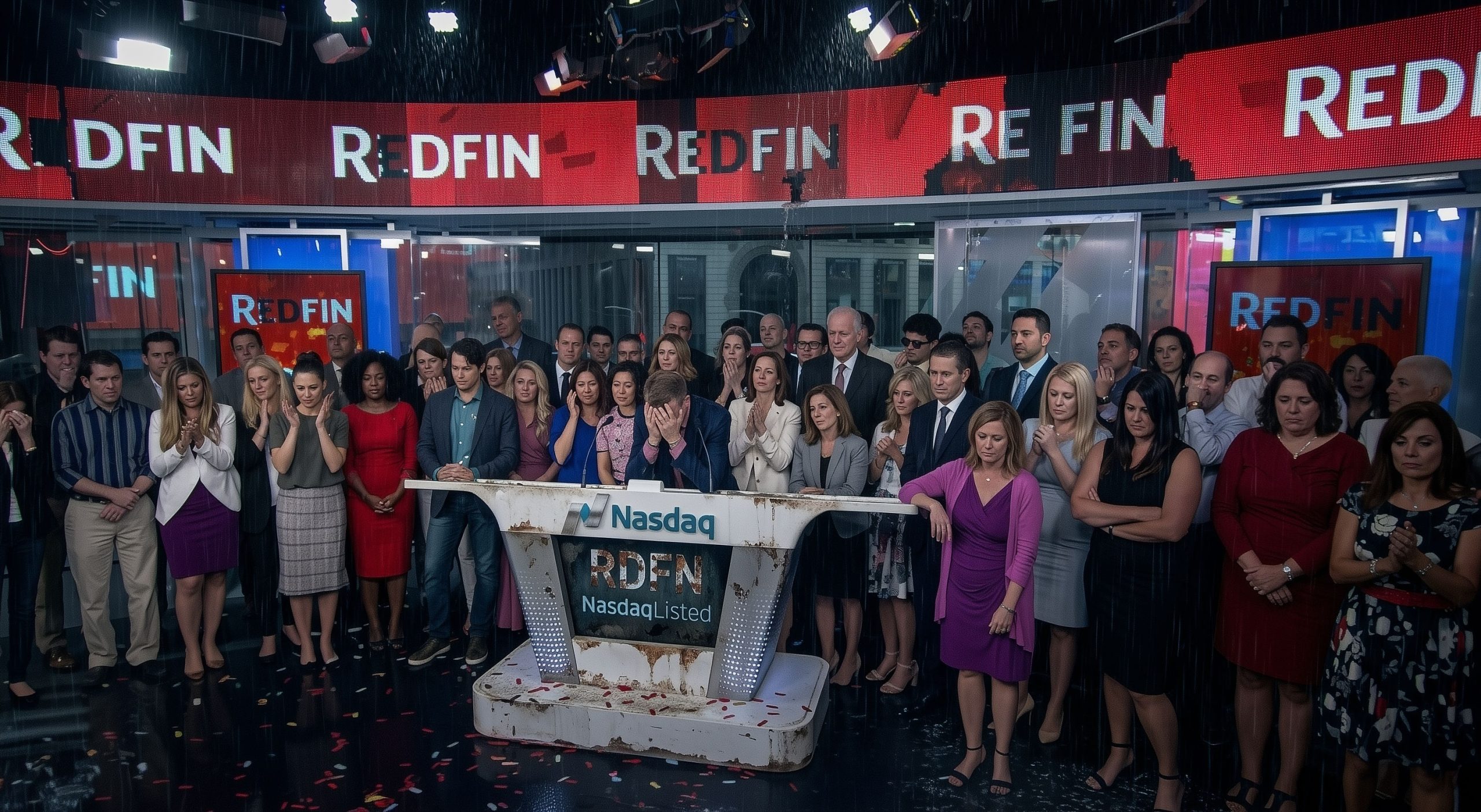
AI-altered image of Redfin executives ringing the NASDAQ opening bell, broken TV screens, everyone is sad, somehow it is raining indoors.

Sharknado: Has the “Shark Genre” Reached its Logical Conclusion? NOPE.

Today on a group chat at work, the topic of “Sharknado” came up. Because of course it did. In said chat, someone linked to an article in which the writer of “Sharknado” claims that “the shark genre has reached its natural and logical conclusion.” I believe that we proved his thesis wrong.

For reference, here is the “Sharknado” trailer:


Sharknado

RT: NPR: ‘Sharknado’ Dares To Ask: Is It Going To Rain Giant Man-Eating Sharks?

YO: I feel like I should revive our shark air-swimmer.

NG: Sharknado was all the rage lat night on Twitter. 9/10 tweets were about it

FN: OMG. Seriously, EVERYONE I follow on Twitter was going nuts about Sharknado.

OS: Fin’s name should have been Foo. Then Foo could have owned a bar, and been friends with Baz.

FN: The company that makes these movies is called The Asylum. They were also responsible for the “Megashark vs.” series and other recent super low budget classics. There was one with a mega piranha. Here’s a 2010 article about The Asylum.

OS: The low-budget big action knock-off is such a funny niche. I’ve been watching a lot of Rifftrax recently of mid-80s straight-to-video knockoffs. There’s always the one or two big-name actors who are slumming or fallen on hard times, the incomprehensible plot, and the strangely professional cinematography and sometimes stunts.

Sharknado

FN: Last sharknado bit from me for today (I have so much work I’m avoiding!): io9 did an excellent interview with the writer.

GR: Ha ha, awesome: “Honestly, I don’t understand why people are so perplexed by this concept. The logic is undeniable.”

TO: That interview is hilarious.

TO: “Has the shark disaster movie run its course, or are we just ramping up? It’s called Sharknado. I think the shark genre has reached its natural and logical conclusion.”

NO: In other words, have shark movies… jumped the shark?

YO: What about sharks in space?

YO: “Freddy vs. Shark”?

OS: “Sharks on a Plane”?

XW: Zombie laser sharks in space. On fire.

OS: Tsusharkmi

GR: What if the Yellowstone Caldera were full of… SHARKS?!? “Megasharkano,” in theaters 2014.

OS: (clap)

RF: “Shark Impact” – Asteroid containing space-sharks on course to destroy Earth. …or would that be “Shark-ageddon”?

Megalodon

OS: Megalogeddadon

RF: Ooh, nice.

RF: I guess for the logic to be undeniable, it would have to be a comet containing frozen space sharks

RF: +1 if the sharks are sentient/intelligent. Then you could pull in the “Independence Day” trope.

ET: RE: intelligent sharks — Deep Blue Sea

RF: @ET good point; the movie should also feature the star power of LL Cool J.

TO: Microscopic sharks (ala Fantastic Voyage; 1966) attacking the body from within!

GR: Megashark vs. Microsharks!

TO: Megashark thinks it killed microshark by eating it, microshark kills megashark from within, microshark dies due to a lifeless host. A shakespearean shark tragedy!

GR: You know what guys let’s just forget this real estate thing and pivot Redfin into a shark disaster movie company.

YO: We can keep the company name.

RF: Can we work zombie sharks into this?

QS: @GR How do you know that this ISN’T a shark disaster movie?

QS: Oh, hang on, guys. I’ll be right back…

RF: Somebody’s at the door!

RF: (Landshark!)

RF: Man, the internets are sadly devoid of any SNL Landshark skits. Wow; first aired in 1975. Now I feel *really* old.

NO: You know what Twilight needed? Hunky teenage sharks.

Vampire Sharks

QS: [Vampire Sharks]

NO: Would vampire sharks work together with vampire ents?

QS: I found this trailer when googling Vampire Sharks. It has, ah, homegrown charm.

RF: How about weresharks?

RF: That would be an unfortunate affliction to have you if you were landlocked during a full moon.


FYI: I anonymized the chat participants and cleaned things up a bit for readability.